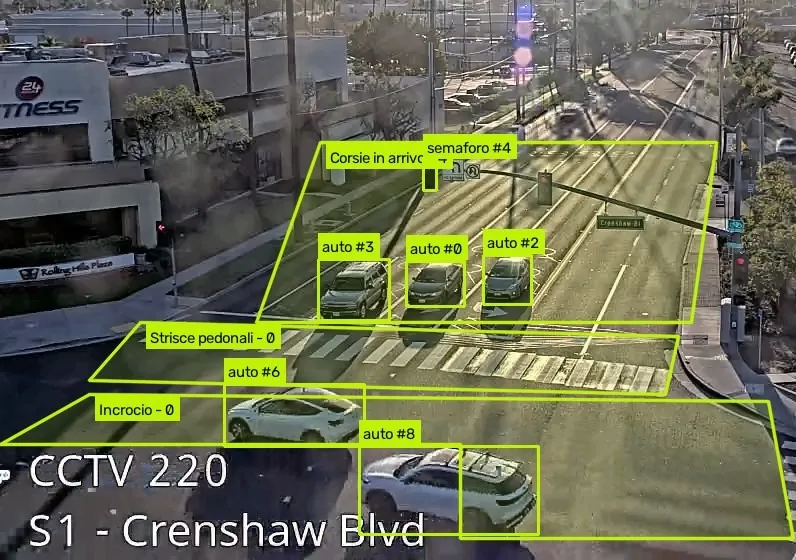
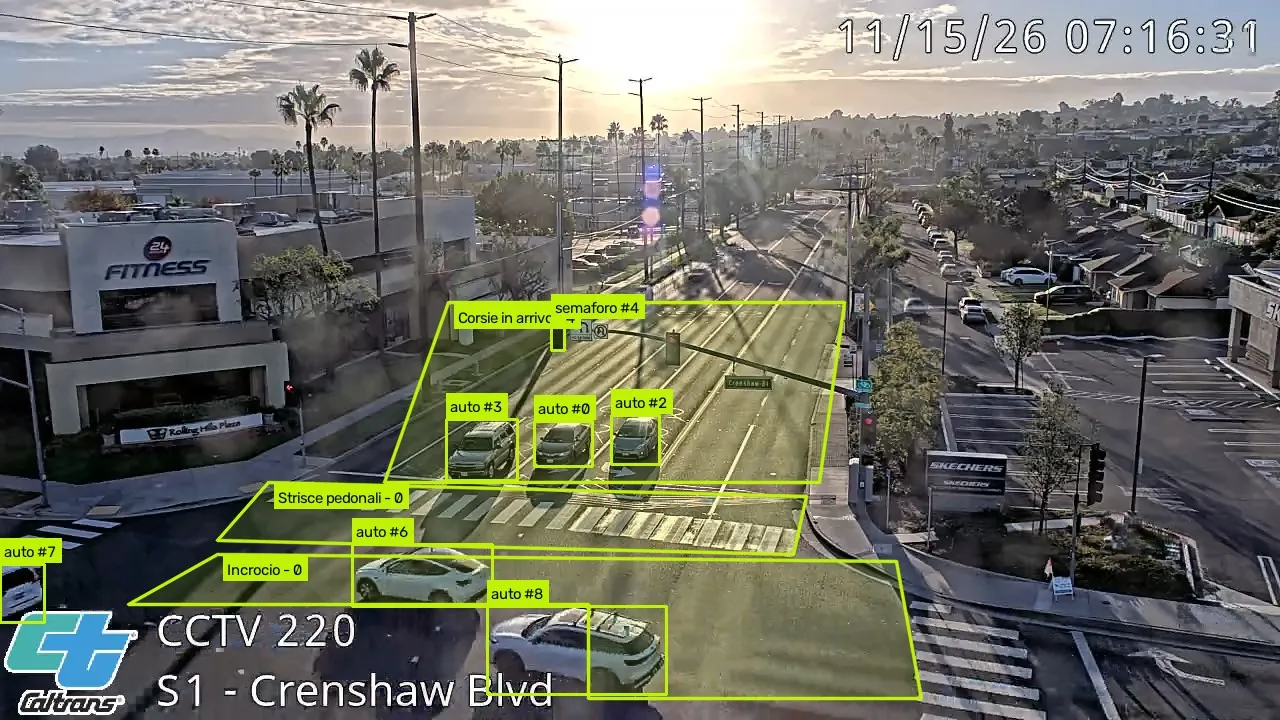
Real frame analysed by AREA · Caltrans public camera, California, used for demonstration
In short
AREA applies object detection to video of roads, stops and car parks. It counts people waiting and parked vehicles, flags vehicles stopped on the carriageway or in restricted areas and people where they should not be, and alerts whoever has to act straight away.
How is computer vision used in transport?
Every road and every car park has different rules. AREA applies computer vision to video of roads, stops and car parks and turns it into events: how many people are waiting, how many vehicles are parked, which vehicle is stopped where it should not be. Find out how AREA works.
How are people counted at stops?
You draw the stop as a zone: AREA counts the people there and alerts you when they exceed the number you choose. It does not recognise emergencies or vandalism on board.
What does AREA do in a car park?
AREA counts the vehicles in a zone and alerts you above a threshold, and flags vehicles stopped in the driving lanes and people in the car park out of hours. It does not show individual free spaces.
How are vehicles stopped on the carriageway flagged?
AREA counts the time a vehicle stays stopped on the carriageway, not the time spent passing, even far from the camera. Beyond the threshold you choose it creates an event with a photo and a clip: it may be a breakdown, an accident or a queue, and whoever has to act sees it.
Does AREA read number plates?
No. AREA recognises vehicles and their type, car, lorry, bus, motorbike or bicycle, but it does not read number plates.
What are the benefits of AREA for urban mobility?
Faster response
A vehicle stopped on the carriageway reaches the panel as it happens, with a photo and a clip.
Continuous counts
People at stops and parked vehicles, counted continuously.
Rules for each camera
Zones, lines, times and thresholds set by you.
Faces blurred
In the live view and in event clips.
Watch AREA at work
50 seconds of real video of a junction analysed by AREA: it counts the vehicles in the “Incoming lanes” and alerts when the queue at the lights exceeds 3 vehicles, while watching the pedestrian crossing and the junction.
Caltrans public camera, California, used for demonstration
What we measured
Neurally internal test, 15 November 2026, on sample videos and public cameras.
- On 2 minutes of a Caltrans public camera in Los Angeles, at 7 in the morning, AREA flagged a queue of more than 3 vehicles at the lights 3 times.
- At night cars were recognised with a confidence between 0.54 and 0.83, but not all of them: one car dazzled by headlights and one partly hidden were missed. That is why we try AREA on your cameras before starting.
- AREA does not read number plates: it recognises the type of vehicle.
Other AREA solutions
Frequently asked questions
AREA’s answers to questions about computer vision for transport and mobility.
What is computer vision used for in transport?
To turn video of roads, stops and car parks into events: how many people are waiting, how many vehicles are parked, which vehicle is stopped where it should not be. Transport companies and councils know as it happens.
Does AREA count people at stops?
Yes. It counts the people in the stop zone and alerts you when they exceed the number you choose.
How does it help in car parks?
It counts parked vehicles and flags those stopped in the driving lanes and people out of hours. It does not show individual free spaces.
Does AREA detect road accidents?
Not directly. It flags vehicles stopped on the carriageway beyond the time you choose, which is often the first sign of an accident or a breakdown.
Does AREA do number plate recognition?
No. It recognises the vehicle type, not the number plate.
How can I try AREA?
Contact us: we will run AREA on a few minutes of video from your cameras and show you the events it finds.
What do you want AREA to see for you?
Couldn’t find the answer you were looking for? Contact us and we’ll get back to you as soon as possible!
Or email us at info@neurally.it or call us on +39 0532 1717097.